Search This Blog

Wednesday, January 9, 2019

The Uh huh method


I posted about the problem of endless rages earlier and got a comment to my latest post on the email from my friend.
She used my Uh huh method, so here it is
The Uh huh Method.
Vets with chronic PTSD can't calm down after they get mad because they have depleted cortisol. I used to keep the fight going by trying to get him to see my point and it would go on and on, him yelling and me trying to make him see "reason", i.e. my point of view. When I found out about depleted cortisol, I stopped trying to get my point across and started saying "Uh huh" or even "You may be right" (notice not are right but may be right, and often adding the thought in my mind, 'on Mars') and letting it go. As a result our fighting stopped for the most part.
Veterans are not raging sh*ts on purpose because they are selfish jerks. They literally do not have the chemical that calms regular people down. I would not be lighting matches around someone on oxygen, so that is the image I use when I am mad at him. He did not choose to have PTSD. He served his country and this is the result. It is invisible, sometimes unpleasant and he is worth it.
I no longer have to be right. I would much rather be happy.

Thursday, December 20, 2018

After the War pamphlet.

I wrote this pamphlet during the first Gulf War for wives because I knew there was nothing out there that explained PTSD simply and how we feel about it. The VA system, well, some of the hospitals used to buy it and give it out. One day I got a call from a Vietnam vet. He said that his therapist at the VA had given him the pamphlet to give to his wife, so of course he read it first, and it was the first time he ever realized that his PTSD could affect his wife! He was blown away. I was so happy to hear that it helped him understand too. I hope it did them some good. Here is the link to "After the War"
http://www.patiencepress.com/documents/After%20the%20War.pdf

Tuesday, December 4, 2018

It is getting close to holiday time, so I am going to mention my articles in the Post-Traumatic Gazette. They are all online at www.patiencepress.com under the tab that says PTSD help.
#10 and #16 both have versions of the article "PTSD and Holidays." One of my therapist subscribers wrote me that some of her vets had their first good Christmas since Vietnam after reading that article.
The next one I wrote is in #22, "Can't you just be normal for one day?" a pretty common and also unreasonable request around this time of year. The article talks about why this is hard and how to accept that and take care of yourself.
in #34 there is an article, "When Holidays Hurt" which might be helpful. if you read the whole issue there is a lovely letter called Welcome to PTSD land in reply to my article in issue #33 also called "Welcome to PTSDland," which is one of my favorites.
#28 has an article on a different kind of New Year's Resolution. #1 has a clear explanation of PTSD in plain English which makes sense. #2 ditto for effects on the family. There are also issues on guilt, dealing with anger in effective ways, grief, feelings, etc. Please check it out if you feel stressed or just want information.

Tuesday, December 19, 2017

Waiting

I have been posting on a couple of Facebook groups that deal with PTSD. On one I can link to stuff I have written already. On the other, I don't think it is allowed so I don't.
I am really finding it so wonderful to be able to help encourage people to look at PTSD as normal and not weird but definitely unusual. For instance, vets with PTSD get enraged by waiting because they are not waiting for whatever it is the person with them is waiting for. For them waiting is dangerous and can get you killed, so while you are waiting to be served, they are waiting for death. It is a really different perspective and makes their reactions more understandable.

Tuesday, October 10, 2017

Solace for the Self

Here is one of my gazettes with a bunch of ways to practice self-care including learning the HEALS technique developed by Dr Stephen Stosny which was one of the things that changed my life.
For some reason the link does not want to post correctly:
http://www.patiencepress.com/documents/V2N1, (Rev) Solace.pdf
as a link so I hope you can copy and paste.
You can also reach it from this page where all the Gazettes are listed. It is No. 7, Solace for the Self.
http://www.patiencepress.com/patien…/PTSD_Help-Gazettes.html

Tuesday, January 31, 2017

KIckass book

Just read a book that kicked my a**, Civilianized by Michael Anthony, who also wrote Mass Casualties: A Young Medic's Story of Death, Deception and Dishonor in Iraq. Both are well written and hard to put down. Civilianized is a post deployment story, sad, funny, upsetting and inspiring. I am very glad this guy made it back and sorry he went through the hell of his own particular war. I highly recommend the book if you would like a taste of reality.
https://smile.amazon.com/Civilianized-Veterans-Memoir-Michael-Anthony-ebook/dp/B01N8S435O/ref=sr_1_1?s=books&ie=UTF8&qid=1485899264&sr=1-1&keywords=michael+anthony

Tuesday, December 20, 2016

Are you having a hard time with the Holidays?


Please go to my website if the holidays are bothering you, or if you are totally numb about them, and look for PTSD and Holidays, Can't you Just Be Normal for One Day, When Holidays Hurt, and any other articles that interest or touch you. I wrote the Gazette for 7 years and much of it is still helpful if you have lived through war or other trauma, or live with a trauma survivor.
http://www.patiencepress.com/patience_press/PTSD_Help-Gazettes.html
Some of the available topics:
PTSD and Holidays
Can't you just be normal for one day?
When Holidays Hurt
PTSD and Physical health, also New Years Resolutions
The war at home
 Why is Daddy Like He is?

Wednesday, October 19, 2016

Last part of What Are Post Traumatic Stress Reactions? from the first issue of the PT Gazette.

Here is the last section of of first article in The Post-Traumatic Gazette #1, copyright Patience Mason 1995, 2005,
What are Post Traumatic Stress Reactions?
Denial and discounting are the skills society has developed to deal with trauma, as expressed in “It wasn’t that bad,” and “Aren’t you over that yet?” Statements like these cause secondary wounding in trauma survivors. They reinforce the mistrust trauma evokes in all survivors who no longer can believe that the universe is fair and just. Secondary wounding by the medical community has been a serious problem, from the incest survivor, revealing her rape by her father and being told by the male psychiatrist (trained to believe this), “You know you wanted it,” to the thousands of misdiagnosed, mistreated Vietnam veterans of the seventies,( many of whom are now dead).
It is a problem that still persists.
In DSM IV, published in 1995, the APA has dropped the list of what is traumatic, and the all important sentence which points out that if it would be upsetting to almost anyone and it isn’t to this person then maybe that’s one of the symptoms of PTSD, and added the peculiar phrase that the person has to have felt “fear horror or helplessness” at the time.
Most trauma survivors that I know can’t feel. The diagnostician or therapist is the one who may be able to call up appropriate feelings (eg. grief, rage) about the incident. The survivor shouldn’t have to and probably can’t without a lot of healing. What this really says is that if bad things happen to you and you don’t feel the authorized feelings, they weren’t bad. This is neither logical nor scientific. It will create a class of good survivors who get diagnosis and treatment, and another (bad) class who due to numbing get misdiagnosed and mistreated, just as veterans were after Vietnam. If the APA really needs to list feelings, a more realistic and more diagnostic set would include disbelief, betrayal, feeling nothing, and feeling comfortable. The latter two would signal to any experienced therapist that this person already had PTSD before this latest stressor. Many people have multiple stressors over the course of a lifetime, and have already developed PTSD long before they see a professional. Most trauma survivors never do see a professional.
Adding the words “fear, horror, or helplessness,” to the diagnosis has made it more inclusive in one important sense. It keeps therapists from “pooh-pooh-ing” experiences that terrified individual survivors. The words fear horror or helplessness were added to the diagnosis because trauma turned out to be far more prevalent than the APA expected. (Yes, I am laughing!) The whole diagnosis of PTSD reflects the upper middle class idea that trauma itself is rare. It ain’t!
Rather than redefining trauma as evoking particular emotions, I’d like to see us open our eyes to the invisible effects of trauma.
We must become aware of the costs to survivors, society and families of all forms of numbing and hyperarousal including socially acceptable dysfunctional behavior. By ignoring it, we often simply put off to the next generation the cost and effort of recovering from trauma, and the effects of trauma increase geometrically. This is particularly true because something which might be mildly traumatic to a grownup, particularly one who is numb, is terrifyingly traumatic to a small child. As Beverly James points out, the well known phenomena of the “good” hospitalized child who “misbehaves” when the parent shows up is actually a terrified traumatized child displaying learned helplessness and the freeze response who becomes brave enough to voice his or her terror when the parents are around.
What else can’t we see?
One of the facts we need to face is that PTSD is an epidemic. For every incest survivor, every battered woman, every combat veteran, every holocaust survivor, every survivor of a fire, plane wreck, night club fire, rape, torture, mugging, hurricane, tornado, earthquake, every cop, nurse, firefighter, EMT, for everyone whose pain is not listened to and felt and accepted and healed, the effects of the trauma spread geometrically. Drug abuse, AIDS, heart disease, obesity, all related to the epidemic of PTSD through the compulsive behaviors people use to numb their pain and the inability to take care of one’s self which numbing causes.
If 17% of the teenagers in Detroit had tuberculosis, it would be a national emergency. Because they have PTSD, and PTSD is not acknowledged nor well understood, no one is talking about it. But we can.
New notes: Because it is so distressing for many professionals to know about trauma, there is a historical record of a period of acknowledgement followed by a period of denial and forgetting. Right now there are conflicting currents. The American Psychiatric Association has transformed the description of traumatic stressors in DSM III into a numbing ritual in which big Latin-rooted words alternate with the word “or” until the person reading it is practically asleep. This makes it hard to comprehend when someone has been traumatized
There are even academics who are once again doubting the diagnosis, saying it is overused. This is quite popular with those who don’t like paying the entire costs of war.
In addition soldiers resent the term PTSD. It feels like a stigma, and is treated as one in some commands. In Canada they use the term Occupational Stress Injury and include anxiety and depression as well as PTSD. Here some military psychiatrists are using CSI, Combat Stress Injury, which service members find less stigmatizing. I suggest Stress Injury with subtypes: Occupational for first responders, peacekeepers, etc; Combat for soldiers; Crime for survivors of rape, incest, interpersonal violence; Disaster; Betrayal; Neglect, etc.
Service members, unlike previous wars, are being sent back into harm’s way on medications with PTSD. This illustrates the ethical problems inherent in military psychiatry, which focuses on getting people back into action. Is it safe? Probably not. People with PTSD can be hypervigilant and overreact, instead of being vigilant and react with appropriate force.
Will it make them worse to go back with PTSD? Yes it will. But that is their job, and many of them want to go.

Tuesday, October 18, 2016

Fifth section of What Are Post-Traumtic Stress Reactions?

I am publishing this on my personal page, on my author page and on my book page, Recovering from the War.
Here is the fifth section of of The Post-Traumatic Gazette #1, copyright Patience Mason 1995, 2005,
What are Post Truamatic Stress Reactions?
A healing perspective on reexperiencing is that this is an appropriate and effective message from the survivor’s inner self that he or she has been through something that is too much to deal with alone. We are human, a species that is interdependent, that forms families, bands, tribes, communities, and talks about stuff. Survivors were not meant to face this alone as if they were polar bears or some other solitary non-verbal species (although they may wish they were).
The brain is a “better-safe-than-sorry” system. It would rather you get a million false alarms than be surprised by danger once. Part of reexperiencing may be the brain going haywire, triggering full alerts in an attempt to keep you safe.
Reexperiencing is circumstantial evidence that a person has been through too much to handle alone. Reexperiencing can also be seen as appropriate and effective because it sends more people to get help than anything else. Finally, human beings are communicators. Turning the flashes of memory in the reptile brain into a narrative memory in the frontal lobes seems to stop most reexperiencing.
Although this is not part of the current diagnostic criteria, I believe the message from the inner self can come as a physical symptom. Somatization (the development of physical symptoms) has disappeared from studies about PTSD although it was the primary symptom in soldiers’ heart, hysteria, railway hysteria, shell shock and combat fatigue. People who will not listen to their own need for healing often experience a lot of physical symptoms. The body is trying to tell the story that can’t be told. In light of George Vaillant’s recent findings that 56% of WWII Harvard-educated combat vets without “diagnosable” PTSD were chronically ill or dead by age 65, this looks like a field ripe for study.
Many trauma survivors also appear to reenact their traumas, self-mutilating, getting themselves into the same type of trouble over and over, or doing to others what was done to them. These behaviors probably serve the same unconscious purpose of speaking the unspeakable. Although such behaviors have been observed, they are not enumerated in the diagnosis yet, and may never be. That doesn’t mean we can’t keep them in mind in our search for healing.
For a survivor to be diagnosed with PTSD, three numbing, two hypervigilant and one reexperiencing symptom have to last a month. If you have seventeen numbing symptoms, one hypervigilant and are not reexperiencing this month you won’t be diagnosed with PTSD, but traumatic events will be ruling your life.
Symptoms may come on soon after the trauma or fifty years later. That is the post in PTSD. It is normal for symptoms to come up again in the face of further trauma and in times of high stress. It is normal to be affected by trauma. 17 % of the teenagers in Detroit have diagnosible PTSD according to one study. Another study showed that 69% of the surviving spouses of police officers killed in the line of duty have diagnosible PTSD. 66% of Vietnam veterans exposed to high war zone stress have had diagnosible PTSD at some time since the war and 33% still do today. Several studies of WWII combat/pow veterans in the hospital for other problems have shown that at least 50% of them have had PTSD and about 30 % still do.
Israeli studies show that people who have been traumatized react faster and more deeply to each subsequent trauma.
In addition, the effects of a traumatic stressor are worse when the cause is human neglect, betrayal, or human cruelty.
There are other post traumatic reactions which have not been studied including workaholism which might be invisible to workaholic doctors. Family system effects are just beginning to be studied, but many survivors manage to look good at great expense to their families. A child playing the role of family hero is not seen as a sign of family dysfunction, but as proof of good psychosocial adjustment. As a community of survivors, family, friends, and therapists, we need to look at our experiences, examining everything to see how it relates to trauma because what happens to people affects them.

Monday, October 17, 2016

The second section of What Are Post-Traumatic Stress Reactions which apparently I forgot to put on Blogspot.


Here are a few more paragraphs of The Post-Traumatic Gazette #1, copyright Patience Mason 1995, 2005.
What are Post Traumatic Stress Reactions?
...Let me emphasize something: this ability to do whatever it takes to survive is God-given or evolution-given, depending on your point of view, but we all have it, and in traumatic enough situations, it will come out or we die. Extreme situations which trigger this reaction again and again may cause survivors to do things in order to survive which can be hard to look back on later.
This survivor part of us is not able to listen to reason either. It does not speak English, nor can it tell time. It is going to be looking for danger from now on whether or not others think it is reasonable.
Real physiological changes occur in the brains of survivors which make them quick to react. In order to live through the trauma, survivors may develop the capacity to go from fine into a killing rage in seconds. That helps them live. They may stop sleeping soundly. Sleep can get you killed. Survivors may be uncannily able to read the moods of those around them because the moods of their abusers defined their lives. They become hypervigilant, searching for physical danger all around and all the time. Due to hypervigilance and lack of sleep, it is hard for them to concentrate on everyday things, although they are concentrating on survival information. They may do poorly in school and believe they are stupid when what they have is a symptom of PTSD. Survivors react faster and more completely to sudden noises (startle response). These are lifesaving skills as long as the survivor is still at risk, still in combat, still living with the batterer or the molester, still living in the bad neighborhood, the bombed-out city. These are reality based, effective survival skills. They keep you alive.
They don’t go away by themselves.
Similarly, shutting down feelings in order to do whatever it takes to survive, or do your job and help others survive, is a reality based survival skill. If you sit down and cry in combat, you will get killed. If you keep screaming while Daddy hurts you, he may kill you. If you cry in the aid station or emergency room, you won’t be able to save as many lives. Numbness is the answer. It is effective. It will help you live. It will help you keep others alive. And your brain’s inborn capacity to rapidly adapt means that what horrifies you the first time becomes nothing much by the third time it happens. But, if you didn’t care, you wouldn’t have to get numb. Being numb is evidence that you do care.
From The Post-Traumatic Gazette #1, copyright Patience Mason 1995, 2005, What are Post Truamatic Stress Reactions? You can see more of this issue on my author page or book page, Recovering from the War

Here is the fourth section of of The Post-Traumatic Gazette #1, copyright Patience Mason 1995, 2005, What are Post Traumatic Stress Reactions?

It is normal to be affected by trauma, butt not every one who is traumatized gets diagnosable Post Traumatic Stress Disorder. There is a great range of post traumatic reactions because people are different, have had different life experiences, and have different capacities and skills. Some people do okay during the trauma, others crack. Some people have no reaction till another trauma, years later. Most people will find that post-traumatic reactions come back when there is subsequent trauma. Some people seem to alternate periods of extensive numbing with periods of explosive hypervigilant behavior or intrusive reexperiencing (the third category of PTSD symptoms). If the alternation is severe enough, they will never be diagnosed with PTSD because the symptoms won’t be present at the same time, but their lives will be scarred by the trauma nonetheless.
These PTSD survival skills tend to become less appropriate and less effective with time and can wind up being really crippling ineffective behaviors. For a healing perspective, we need to keep in mind that the behaviors of trauma survivors are direct evidence, sometimes the best evidence, of what they have survived, of their experience. They are also evidence of ingenuity, creativity and courage. Reframing the behaviors in this light can be an enlightening experience for the survivor, families, friends, and therapists. Instead of being bad behaviors, they become useful evidence about the nature of the trauma or traumas and the guts and brains of the survivor, who, after all, survived.
Along with three numbing symptoms and two hypervigilant symptoms, to be diagnosed with PTSD, survivors must also reexperience the trauma in some form. The most dramatic of these reexperiencing phenomena, the flashback, forced the recognition of PTSD by psychiatrists.
Psychiatrists were trained to deny that traumatic events did affect people despite evidence from concentration camp survivors and World War II veterans. When Vietnam veterans were having flashbacks in the halls of the VA hospitals, some professionals were able to break this denial and see real people really suffering. They had to acknowledge the flashbacks, so they created a diagnosis centered around reexperiencing reactions. Psychiatrists tend to think of it as a wierd reexperiencing disorder instead of a natural-but-now-not-so-useful survival-skill disorder. I think a more healing perspective focuses on the effectiveness of the skills the person developed to survive, (hyperalertness and numbing). The other approach makes it easy to stigmatize survivors for the very behaviors which helped them survive.
Apparently sharing about traumatic experiences is also necessary for human beings because people who can’t, for whatever reason, develop reexperiencing symptoms. Survivors are reexperiencing when they cannot stop thinking (or talking) about the trauma, when they are dreaming about it, or flashing back to the experience, feeling like it is happening again, even if they are drunk or on drugs. Reexperiencing also includes being upset on anniversaries of the trauma or by things that remind the survivor of the trauma. New wars, highly publicized rape, murder, battering and incest trials all affect survivors. Having a physiological reaction to something that reminds the survivor of the trauma is also a form of reexperiencing. The sound of a helicopter overhead sends a rush of adrenaline through many veterans. Someone raped in a stairwell may find herself sick and dizzy in any stairwell.

Sunday, October 16, 2016

Here is the third section of of The Post-Traumatic Gazette #1, copyright Patience Mason 1995, 2005, What are Post Truamatic Stress Reactions?

Here is the third section of of The Post-Traumatic Gazette #1, copyright Patience Mason 1995, 2005, What are Post Truamatic Stress Reactions?
This doesn’t go away by itself either.
Unfortunately when survivors numb fear, despair and anger, all their feelings, even good ones, are numbed. Numbness is comfortable. Thinking about what they have been through is so painful, survivors wind up avoiding thinking about, feeling, or doing anything that reminds them of the trauma. For example, if they feel the trauma was their fault, they may spend the rest of their life having to be right so they won’t ever be at fault again. If they were happy when the trauma hit, they may avoid happiness forever. If they lost those close to them, they may give up closeness.
Most trauma survivors do not know anything about PTSD, so instead of seeking help, they will turn to whatever is available, self-medicating to maintain numbness. Addictions and compulsive behaviors often are rooted in attempts to numb the thoughts and feelings associated with trauma. Until recently, a diagnosis of alcoholism or drug abuse made the effects of trauma invisible: because he’s (or she’s) an alcoholic, alcoholism is the cause of all these problems so he (or she) can’t have PTSD.
“Inability to recall important aspects of the trauma,” is another of the ways avoidance and numbing may work. This means the person cannot remember exactly what happened. Many trauma survivors forget in order to survive. This is well documented in the scientific literature for combat veterans, torture survivors, battered women, child sexual abuse survivors, natural disaster survivors and others, as well as in personal narratives. The current attack on traumatic amnesia by the parents of incest survivors, involving memory experts who know nothing about trauma and therapists who were trained back in psychiatry’s denial and delusion period (from Freud to 1980), will be the subject of a future issue.
Survivors usually also feel that no one can understand what they’ve been through, which is reality. Another form of numbing and avoidance is that they may feel like they’re not going to have a long life. This is realistic if the survivor has seen a lot of people killed. Survivors may also lose interest in what they once liked to do. What is the point? Small children are likely to go back to baby talk or forget their toilet training. Survivors may also feel like they have no emotions or be told by their loved ones that they have none. They may even be so numb to the damage that was done to them that they become perpetrators and cannot understand what the fuss is all about. “What are you crying for? I’m pulling my punches.”
Survivors may also have learned to dissociate, to literally not be there, to survive. Automatically checking out of stressful situations will make it hard to have relationships or to work in therapy.
Numbness will make it hard for survivors to take care of themselves. Feelings are there to tell us how to do that. If you can’t tell what you feel, you can’t choose healthy behaviors for yourself.
I’ve just described two of the symptom categories psychiatrists use to diagnose PTSD: hypervigilance and numbing. I’ve described them in this way because I think it is important for survivors, families and therapists to understand that this is not some random collection of weird behaviors, but appropriate and effective biologically based reactions to extreme stress. They have a purpose: survival. These reactions develop under conditions that most of us cannot imagine or comprehend, although such conditions are common in our society.
A person has to have two hypervigilant symptoms and three numbing symptoms, not present before the trauma, to be diagnosed with Post-Traumatic Stress Disorder. That means if the survivor already had PTSD from a previous trauma which the therapist doesn’t know about and is already numb, the survivor may be misdiagnosed.
Most trauma survivors turn out to have multiple traumas, but the diagnosis of PTSD was formulated as if trauma was rare and only happened in isolation from the rest of life.

Saturday, October 15, 2016

What are Post-Traumatic Stress Reactions? Part 1 (from Vol. 1, No. 1, The Post Traumatic Gazette, Revised © 2002 Patience H. C. Mason May-June 1995)

Post-Traumatic Stress reactions start with a traumatic stressor “outside the range of usual human experience and that would be markedly distressing to almost anyone,” according to the American Psychiatric Association’s Diagnostic and Statistical Manual, III-R. Since it is almost impossible for a non-survivor, or a numb survivor, to understand or imagine what a survivor experiences at the time of the trauma, and therefore to identify what is traumatic, the DSM III-R offered four categories of traumatic stressor for diagnosticians and therapists: (1)-threat of death or loss of physical integrity to the survivor (combat, rape, incest, earthquake, etc.), (2)-death, threat of death or loss of physical integrity to family or close friends (survivor does not have to be present) (3)-sudden loss of home or community, and (4)-seeing another person who has recently been seriously injured or killed. These were derived from reality: real nurses and body-baggers had terrible PTSD, just like combat vets, rape and incest survivors, people who lost their homes in fires or floods, or lost their kids on Flight 103 over Lockerbie or in the World Trade Center. Interestingly enough, DSM IV basically contains a legalese mumbo-jumbo numbing ritual which enables professionals to not think about the reality.
As a person is traumatized, at least for the first time,* the sense of personal safety is shattered. Two things start to happen immediately. The person will strive to survive using three available systems: fight, flight or freeze. What they called the reptile brain in high school biology seems to take over and choose. Military training is designed to get soldiers to always choose fight, but they wouldn’t have to train us to do that if we were natural born killers. Culture and religion often train women to freeze, to take it and endure. In nature, flight is most common.
Simultaneously, while survival is at stake, feelings will shut down and information taken in and processed will become focused so the person can do whatever it takes to survive.
Whatever it takes! This is not a polite, well-behaved part of us. It pisses and shits in its fear. It scratches and bites and goes berserk, beating people to death with the rifle-butt when the bullets are gone. It kicks and gouges. It runs out on its friends, trampling whoever gets in its way. It cowers, unable to get up or to fight, unable to protect those it loves. It may freeze or follow orders that are against all the survivor personally believes in. Survivors may feel shock or shame over what this part of them did.
Let me emphasize something: this ability to do whatever it takes to survive is God-given or evolution-given, depending on your point of view, but we all have it, and in traumatic enough situations, it will come out or we die. Extreme situations which trigger this reaction again and again may cause survivors to do things in order to survive which can be hard to look back on later.
This survivor part of us is not able to listen to reason either. It does not speak English, nor can it tell time. It is going to be looking for danger from now on whether or not others think it is reasonable.
Real physiological changes occur in the brains of survivors which make them quick to react. In order to live through the trauma, survivors may develop the capacity to go from fine into a killing rage in seconds. That helps them live. They may stop sleeping soundly. Sleep can get you killed. Survivors may be uncannily able to read the moods of those around them because the moods of their abusers defined their lives. They become hypervigilant, searching for physical danger all around and all the time. Due to hypervigilance and lack of sleep, it is hard for them to concentrate on everyday things, although they are concentrating on survival information. They may do poorly in school and believe they are stupid when what they have is a symptom of PTSD. Survivors react faster and more completely to sudden noises (startle response). These are lifesaving skills as long as the survivor is still at risk, still in combat, still living with the batterer or the molester, still living in the bad neighborhood, the bombed-out city. These are reality based, effective survival skills. They keep you alive.
They don’t go away by themselves.
Similarly, shutting down feelings in order to do whatever it takes to survive, or do your job and help others survive, is a reality based survival skill. If you sit down and cry in combat, you will get killed. If you keep screaming while Daddy hurts you, he may kill you. If you cry in the aid station or emergency room, you won’t be able to save as many lives. Numbness is the answer. It is effective. It will help you live. It will help you keep others alive. And your brain’s inborn capacity to rapidly adapt means that what horrifies you the first time becomes nothing much by the third time it happens. But, if you didn’t care, you wouldn’t have to get numb. Being numb is evidence that you do care.
From The Post-Traumatic Gazette #1, copyright Patience Mason 1995, 2005, What are Post Truamatic Stress Reactions?

Friday, May 6, 2016

My letter on getting service connected for PTSD.

I was on Facebook with a group for wives and found out the VA and Army, and other services are giving people "adjustment disorder" or"Unspecified trauma and stressor related disorder." WTF!! So I posted this and I am posting it here. These ignorant examiners are lower than whale shit. Write out in your won handwriting your stressors and symptoms and remember that a traumatic brain Injury is ALSO A TRAUMATIC STRESSOR!!
And don't be too proud to tell them your symptoms.

Dear Veteran,
I’m writing to give you encouragement about the struggle to get a VA rating for PTSD. I suggest writing out the claim in your own handwriting and taking it with you to the interview and giving it to the examiner. Tell him or her to attach to your claim. Keep a xerox copy. Do this every time you go for an interview and every time you
appeal, which you will probably have to do because if you have PTSD they will try to give you the lowest rating they can get away with. You need to be persistent and to supply them with concrete (written) evidence for your claim. You will also need to do this every two years when they review your case.
What you have to have:
A traumatic stressor: a-threat of death or bodily injury to yourself (ie. combat, friendly fire, being mortared or rocketed, wounded, captured, driving a truck on a mined road, flying in a helicopter that was shot at, jumping out of a helicopter into a hot LZ. I’m sure you have more than one. list them all);
b-threat of death or bodily injury to someone you are close to (if you had a buddy who was wounded or lost squad members, family member) c-sudden loss of home or community (squad wiped out, hooch or hospital mortared, evacuated due to wounds, etc.) or d-seeing anyone who has recently been killed or injured (being a
medic or nurse on a trauma ward, body bagging, seeing someone you didn’t know killed, seeing kids, women or other Americans or civilians who had been killed, or wounded, etc.). You probably have a large number of these. They want you to have felt fear, horror or helplessness at the time, so say that you did. You can probably
remember how you felt the fear, horror or helplessness the first time or so that you saw death and how later you got numb to it because that numbness is a symptom of PTSD. Write out at least one of these stressors (or as many as you remember if you can) and write that you felt one or more of those emotions. It doesn’t have to be detailed. The bald facts will do.
Then you have to have one reexperiencing symptom, but include all that you have: these include nightmares, not being able to stop thinking about the war, getting really upset at things that remind you of the war including anniversaries, as well as flashbacks where you might feel like you’re back there for a moment . Also if the
sound of a Huey going over gets your adrenaline going (or any other thing that reminds you of your particular war if it wasn’t Vietnam) causes physiological arousal, that’s a physiological reexperiencing symptom which you should list.
Next you need three numbing symptoms. They are:
a- efforts to avoid thought or feelings associated with the trauma (If you try not to think about the war or if you try not to feel love because you lost a beloved buddy, try never to feel guilt because you think you fucked up over there, try never to be happy because you were ambushed when you were feeling fine, those are all examples. So is trying never to get angry because you’re afraid of what you might do. So is staying drunk or drugged, but I would not bring that up unless they try to say that’s your problem):
b-efforts to avoid activities or situations associated with the trauma (never watch war movies, don’t hunt, don’t go to veterans day parades or associate with other vets, can’t stand authority figures because of the REMF’s or the lifers, etc);
c-inability to recall important aspects of the trauma (particular battles or periods of time that you can’t remember or whether those guys were killed or just wounded are all symptoms of PTSD. Use it as such);
d-markedly diminished interest in significant activities (what did you used to do that you don’t since your PTSD came on? Lots of guys with PTSD stay home watching TV which is this symptom. Others still get out but they’ve given up hunting, or going places where there are crowds or whatever).
e-feeling of detachment or estrangement from others (No one can understand what it’s like. I’m on the outside looking in at all these people who haven’t a clue. I don’t care about things or people the way I used to).
f- restricted range of affect (feelings) for example unable to have loving feelings (unable to cry when parent dies or kid dies, told
you have no feelings, can’t feel love for wife, etc).
g- sense of a foreshortened future: does not expect to have
a career, marriage, children, or a long life (may be still driving drunk or stoned, still jumping out of airplanes or taking other risks, afraid to commit to anyone or anything etc.). This all has to be written out too. Well it doesn’t have to be—I’m not trying to boss you around here— but examples of three of them will establish your
case and the more concrete examples the better to buttress your case.
The last set of symptoms, you need two of these, are “symptoms of increased arousal not present before the
trauma” which include
a-difficulty falling or staying asleep,
b-irritability or outbursts of anger,
c-difficulty concentrating
(Read a page and can’t remember it? Forget what your wife just told you or constantly hear “I told you that yesterday!” Feel dumb because you don’t follow a lot of conversations, etc, or just can’t focus because part of you is scanning for danger all the time?), d-hypervigilance (always looking for danger, worrying about
people getting hurt, still looking for tripwires and sitting with your back to the wall, avoiding crowds, etc),
e: exaggerated startle response (hit the dirt at the sound of a backfire, can’t be touched when asleep, etc).
You have to have had the symptoms for a month or more. Mention how they have affected your ability to get and retain employment, your social and your intimate relationships.
Beyond taking a description of your traumatic experiences in your war and your current symptons to the interview,
I also suggest taping the interview. Here in Gainesville, FL, the only time the VA Compensation examiner asks you about your experiences in the war or your symptoms is when you are recording the interview.
Otherwise he doesn’t ask and so he doesn’t report and you don’t get service connected. Remember they need this information spelled out to service connect you.
If you were given another psychiatric diagnosis before 1980 (or even later in most VA’s) you may need to point out to the examiner that during that period, there was no such diagnosis as Post-Traumatic Stress Disorder
available. The examiner may not be aware of this fact.
The compensation and pension (C&P) examiner is required to ask for a social history, stressor history, past and present symptoms both subjective and objective. This takes time. If the correct proceedure wasn’t followed (like it was a short exam or the examiner didn’t ask you specific questions about your social history, stressor history, past and present symptoms both subjective and objective), you can immediately in writing request another exam because that exam was" not adequate for compensation purposes." You don’t have to wait for them to make a decision and getback to you.
I hope this helps. Best of luck.
Thanks and Welcome Home!
Patience Mason, Editor, The Post-Traumatic Gazette
author of Recovering From the War

Sunday, February 7, 2016

New book idea #1

I thought I would start posting stuff here about my ideas for a new book on PTSD, a sort of handbook where you can look up a symptom or a treatment and see what is known about it.
I just finished a book called After Action by Dan Sheehan. I highly recommend it and his second book, Continuing Actions. He was a Marine Cobra pilot in the invasion of Iraq, but for me the importance of the book is that he noticed he was affected, tried not to be, and eventually realized that if he did not deal with what he was trying not to feel, it would affect his kids. 
This is an insightful man! 
He was also much older than, for example, my husband who went into combat at 22, or the 18 year old grunts in most wars...
My favorite line in the book: "But I wasn't interested in being honest–I wanted to be fine."
I have never met a veteran who didn't want to be fine.
So this got me thinking about the use of fine as an acronym, which Bob claims I only like because it has the word fuck in it. (Probably true!)
The acronym: fucked up, insecure, neurotic and emotional, according to some AA people I know.
I go for fucked up. A lot of vets feel that war fucked them up even though they don't want to admit it.
Insecure works for me, too. Most vets are super aware of danger and may even read danger into many things.
Neurotic means nothing to me, so I would substitute numb for that, since being numb keeps you able to do your job in the midst of danger and chaos. Finally I think emotional is a good thing when you are not in combat, so I put egotistical in it's place.

So the page in my new book would read something like this:

I'm FINE.
Many people are actually happy, productive, relaxed and aware when they say they are fine.
Some people say they are fine to deflect attention from how they do feel because they were taught that this was the only acceptable answer. Anything else makes you a wuss, a whiner, a loser.
Reality is that most people who come back from war, or survive another trauma, are not fine, so if that might fit you, here are some questions to think about:
How or why might you be fucked up? Are you saying or thinking if you'd been through what I've been through, you'd be fucked up too? If you had my wife, husband, boss, kids, etc.
How are you insecure? Are you sleeping with a gun? Driving like a maniac? Not trusting anyone?
How are you numb? Do you have to be in danger to feel alive? Can you feel sad? Can you feel love?
How are you egotistical? Do you want everything your way? Is there flexibility in your relationships? Do you yell if things are not done 'right'?
Think about these questions and see if you are actually fine or not.

So that would be one page in the book, and I would like feedback on the idea. Please post it here on the blog.

Friday, May 15, 2015

Bob suggested I write up a set of Q & A for an advice column on PTSD and try and sell it to a newspaper or something. It is really what I love to do, but do I have the energy? It would be easy if someone else came up with the questions...
I have a blog at PatienceMason.blogspot.com http://www.patiencepress.com/pat…/PTSD_Help-For_Spouses.html and two other facebook pages, Patience H C Mason, Author and Recovering From the War.
Last Year in June (PTSD Month) I posted everyday here and cross posted to all of them. I think it helped some people.
I keep directing people on some of the groups I belong to to http://www.patiencepress.com/pat…/PTSD_Help-For_Spouses.html which also links to the stuff for kids, the Gazettes and various essays. I have written so much on this subject and few people know, but 

I really think my non-professional take on PTSD is way more helpful than the way professionals look at it as a random collection of symptoms with no rhyme or reason. 
I see it as survivor skills built into your brain which are rapidly/instantly activated by war or abuse and which play out in a logical order, hyperalertness and rapid adaptation leading to numbing and then avoidance, ending up with re-experiencing symptoms like nightmares, intrusive thoughts, flashbacks, anniversary reactions to incidents you may or may not remember, one of the commonest causes for a resurgence of PTSD symptoms.
The other common cause for a resurgence is a new stressor which, having been to war, may not seem like it ought to bother you, but suddenly you are keyed up, angry etc.
I'd be glad for suggestions or inspiration.

Thursday, May 7, 2015

To my Congressman about marijuana

When Bob got back from Vietnam
 anyone who had problems was treated badly at the local VA where they were rude and dismissive. The diagnosis of PTSD did not exist. There was no treatment except valium, and he was told to take all he wanted since it was the new wonder drug. He also drank heavily. The students at UF introduced him to pot.
Bob survived BECAUSE he had these three drugs to use. Not because he got help at the VA. Not because I helped him. Because drinking, smoking pot and taking lots of valium just kept him down to WIRED. He could not sleep. Sleeping pills kept him awake. He was irritable and angry a lot, numb a lot, but whatever he was, the pot HELPED.
It helped him and it helped me because it calmed him down.
I think it should be available to every veteran.

What I wrote Ted Yoho, a supposedly pro-vet Congressman in Florida:
'I happen to live with a vet who has PTSD and who has suffered a lot as a result. I have written a book called Recovering From The War and have a website on recovering from PTSD, which involves different things for different people. http://www.patiencepress.com/patien…/PTSD_Help-Gazettes.html
I believe that with so many veterans killing themselves or hurting their families with outbursts of anger etc, they should be provided with something which will help them NOW, not after weeks of therapy, if they can even be seen in the VA or find a therapist who understands. Medications may help, but if they have bad side effects, most vets won't take them and won't say they are not. They give up. Pot just makes them feel better and it should be available. For years after Vietnam, it was the only thing that helped my husband and I was glad he had it.
I know you won't agree, but I wanted to let you know that you could have helped our veterans and you didn't. 

It is not an ideal solution, but it is something that has helped many. "

I wrote this when I signed a letter to Representative Yoho about the fact that VA doctors can't even talk to vets about pot, thanks to a recent vote. The letter came through the Drug Policy Alliance
http://www.drugpolicy.org/

Friday, April 3, 2015

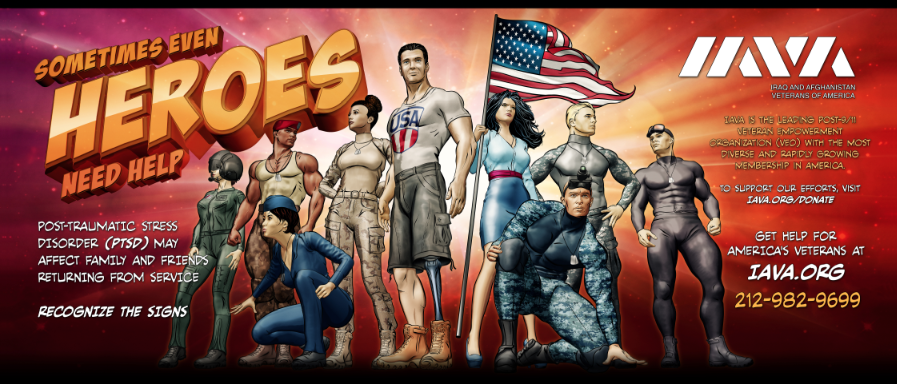
I love this poster. Wish IAVA knew that my website (patiencepress.com) exists with a lot of help on it.
It is normal to be affected by what you live through!
Different people need different things to get better.
There is no pill for PTSD and no therapy that works for everyone (no matter how "evidence based").
The symptoms of PTSD all start in the primitive parts of the brain as brain based survival skills: attention to threat leads to hypervigilance; rapid adaptation to what's happening leads to numbing and then avoidance to stay numb (including alcoholism, drugs, and other addictive behaviors); and the brain's better safe than sorry system, which does not speak English and can't tell time (except when anniversaries roll around) tries to keep you aware that the universe is a dangerous place with intrusive thoughts, flashbacks, nightmares, and anniversary reactions.
NORMAL, people! Not weak! Not weird! We are made to survive if possible.
Having PTSD is evidence that you have been through traumatic events and also evidence of strength, courage, speed, luck, etc, and survival! I am glad you lived through it and made it home.

Monday, January 19, 2015

Do you still think of Vietnam by Kerry "Doc" Pardue,

This is a beautiful essay!


Do you still think of Vietnam?

by Kerry “Doc” Pardue
A couple of years ago someone asked me if I still thought about Vietnam. I nearly laughed in their face. How do you stop thinking about it? Every day for the past forty years, I wake up with it- I go to bed with it. This was my response:
“Yeah, I think about it. I can’t stop thinking about it. I never will. But, . I’ve also learned to live with it. I’m comfortable with the memories. I’ve learned to stop trying to forget and learned to embrace it. It just doesn’t scare me anymore.”
A lot of my “brothers” haven’t been so lucky. For them the memories are too painful, their sense of loss too great. My sister told me of a friend she has whose husband was in the Nam. She asks this guy when he was there.
Here’s what he said, “Just last night.” It took my sister a while to figure out what he was talking about. Just Last Night. Yeah, I was in the Nam. When? Just last night, before I went to sleep, on my way to work this morning, and over my lunch hour. Yeah, I was there
The Wall
My sister says I’m not the same brother who went to Vietnam. My wife says I won’t let people get close to me, not even her.They are probably both right. Ask a vet about making friends in Nam. It was risky. Why? Because we were in the business of death, and death was with us all the time. It wasn’t the death of, “If I die before I wake.” This was the real thing. The kind boys scream for their mothers. The kind that lingers in your mind and becomes more real each time you cheat it. You don’t want to make a lot of friends when the possibility of dying is that real, that close. When you do, friends become a liability.
A guy named Bob Flanigan was my friend. Bob Flanigan is dead. I put him in a body bag one sunny day, April 29, 1969. We’d been talking, only a few minutes before he was shot, about what we were going to do when we got back to the world. Now, this was a guy who had come in country the same time as me. A guy who was loveable and generous. He had blue eyes and sandy blond hair.
When he talked, it was with a soft drawl. I loved this guy like the brother I never had. But, I screwed up. I got too close to him. I broke one of the unwritten rules of war. DON”T GET CLOSE TO PEOPLE WHO ARE GOING TO DIE. You hear vets use the term “buddy” when they refer to a guy they spent the war with. “Me and this buddy of mine.”
Friend sounds too intimate, doesn’t it? “Friend” calls up images of being close. If he’s a friend, then you are going to be hurt if he dies, and war hurts enough without adding to the pain. Get close; get hurt. It’s as simple as that. In war you learn to keep people at that distance my wife talks about. You become good at it, that forty years after the war, you still do it without thinking. You won’t allow yourself to be vulnerable again.
My wife knows two people who can get into the soft spots inside me-my daughters. I know it bothers her that they can do this.It’s not that I don’t love my wife. I do. She’s put up with a lot from me.She’ll tell you that when she signed for better or worse, she had no idea there was going to be so much of the latter. But with my daughters it’s different. My girls are mine. They’ll always be my kids. Not marriage, not distance, not even death can change that.They are something on this earth that can never be taken away from me. I belong to them. Nothing can change that. I can have an ex-wife; but my girls can never have an ex-father. There’s the differance. I can still see the faces, though they all seem to have the same eyes. When I think of us, I always see a line of “dirty grunts”sitting on a paddy dike. We’re caught in the first gray silver between darkness and light. That first moment when we know we’ve survived another night, and the business of staying alive for one more day is about to begin. There was so much hope in that brief space of time. It’s what we used to pray for. “One more day, God. One more day.”
And I can hear our conversations as if they’d only just been spoken I still hear the way we sounded. The hard cynical jokes, our morbid senses of humor. We were scared to death of dying, and tried our best not to show it.
I recall the smells, too. Like the way cordite hangs on the air after a fire-fight. Or the pungent odor of rice paddy mud. So different from the black dirt of Iowa. The mud of Nam smells ancient, somehow. Like it’s always been there. And I’ll never forget the way blood smells, sticky and drying on my hands. I spent a long night that way once. The memory isn’t going anywhere.
I remember how the night jungle appears almost dreamlike as pilot of a Cessna buzzez overhead, dropping parachute flares until morning. That artificial sun would flicker and make shadows run through the jungle. It was worse than not being able to see what was out there sometimes. I remember once looking at the man next to me as a flare floated overhead. The shadows around his eyes were so deep that it looked like his eyes were gone. I reached over and touched him on the arm; without looking at me he touched my hand. “I know man. I know.” That’s what he said. It was a human moment. Two guys a long way from home and scared to death.
God, I loved those guys. I hurt every time one of them died. We all did. Despite our posturing. Despite our desire to stay disconnected, we couldn’t help ourselves. I know why Tim O’ Brien writes his stories. I know what gives Bruce Weigle the words to create poems so honest I cry at their horrible beauty. It’s love. Love for those guys we shared the experience with.
We did our jobs like good soldiers, and we tried our best not to become as hard as our surroundings.You want to know what is frightening. It’s a nineteen-year-old-boy who’s had a sip of that power over life and death that war gives you. It’s a boy who, despite all the things he’s been taught,knows that he likes it. It’s a nineteen-year-old who’s just lost a friend, and is angry and scared and, determined that, “some*@#*s gonna pay”.To this day, the thought of that boy can wake me from a sound sleep and leave me staring at the ceiling.
As I write this, I have a picture in front of me. It’s of two young men. On their laps are tablets. One is smoking a cigarette. Both stare without expression at the camera. They’re writing letters. Staying in touch with places they rather be. Places and people they hope to see again. The picture shares space in a frame with one of my wife.. She doesn’t mind. She knows she’s been included in special company. She knows I’ll always love those guys who shared that part of my life, a part she never can. And she understands how I feel about the ones I know are out there yet. The ones who still answer the question, “When were you in Vietnam?”
“Hey, man. I was there just last night.”
~Kerry “Doc” Pardue

Sunday, December 7, 2014

Holiday stuff from the Post-Traumatic Gazette


For anyone who is having a hard time at this time of year, here are all my holiday articles:
http://www.patiencepress.com/doc…/V3N4PTSDand%20Holidays.pdf
http://www.patiencepress.com/documents/V4N4Normal.pdf
http://www.patiencepress.com/docume…/V6N4Holidays%20Hurt.pdf
and on on New Years Resolutions which is not the headline article
http://www.patiencepress.com/do…/V5N4%2828%29%20Physical.pdf